Curious about OCD and TMS This guide explains how treatment protocols work, what to expect at our Atlanta and Decatur clinic, and how TMS and ERP can work together.


Table of Contents
If you live with upsetting thoughts that loop in your mind and feel pushed to repeat certain actions to feel safe, you may wonder how OCD and TMS fit together. You might also hear your therapist talk about ERP and feel unsure how all of these treatments connect.
This guide explains in simple language how OCD and TMS work, what a typical TMS protocol looks like, and when it makes sense to combine TMS with ERP at Atlanta Spravato and TMS Center.
What is OCD and how is it usually treated
Obsessive compulsive disorder or OCD is a mental health condition where you have intrusive thoughts or images and strong urges to perform rituals or routines. These thoughts and actions can take up a lot of time and cause real distress in daily life. (National Institute of Mental Health)
The main first line treatments for OCD are
- Medicines such as selective serotonin reuptake inhibitors
- Cognitive behavioral therapy that uses exposure and response prevention also called ERP
ERP teaches you to face fears in a step by step way and then gently resist the urge to do compulsions. Over time your brain learns that anxiety can rise and fall on its own and that you do not need rituals to be safe. Large clinical studies show that ERP is highly effective for OCD for many people. (National Institute of Mental Health)
Still some people only get part way better. Others feel so anxious or depressed that they cannot fully engage in ERP. This is where OCD and TMS may enter the picture as an added tool rather than a replacement.
What is TMS for OCD
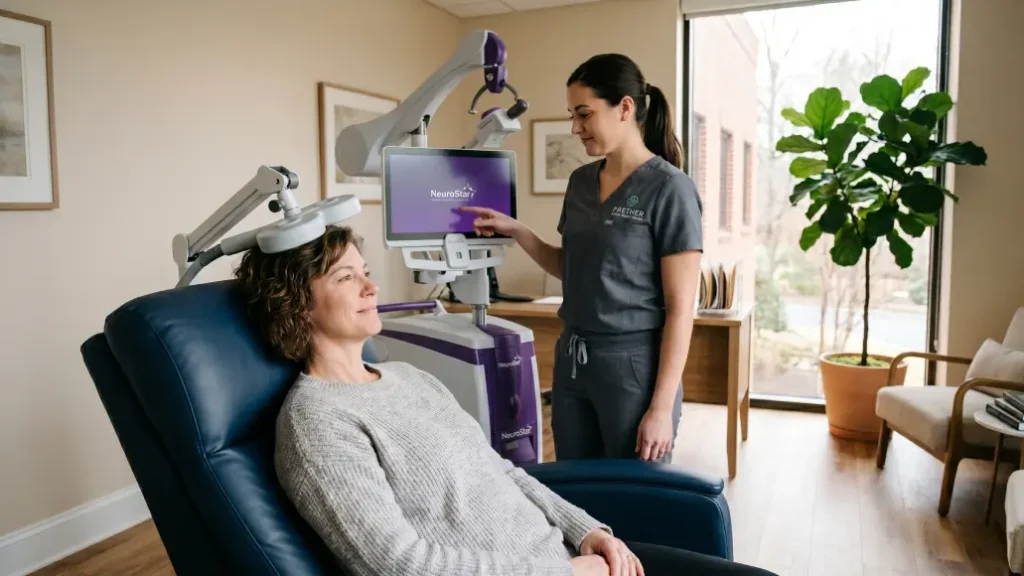
Transcranial magnetic stimulation or TMS is a noninvasive brain treatment. A treatment coil rests on the scalp and sends short magnetic pulses into specific brain areas that are involved with mood, fear, and habit loops. You are awake, sit in a comfortable chair, and can return to normal activities right after the session. Common side effects are mild scalp discomfort or headache that usually fade over time. (Mayo Clinic)
In two thousand eighteen the United States Food and Drug Administration cleared a form of deep TMS as an add on treatment for adults with OCD who still have symptoms despite medicine or therapy. (U.S. Food and Drug Administration) Research since then suggests that TMS can produce a moderate improvement in OCD symptoms for many patients who complete a full course. (PubMed)
At Atlanta Spravato and TMS Center we use NeuroStar TMS, an FDA cleared system that delivers focused magnetic pulses to brain regions linked to mood and anxiety circuits. The goal is to restore more balanced activity in these networks without daily medicine side effects. (Atlanta Spravato & TMS Center)
Typical TMS protocols for OCD
Every patient receives a custom plan, but most TMS protocols for OCD share several features.
- Session length
Many OCD protocols use sessions that last around twenty minutes. During that time you receive many short bursts of magnetic pulses in a pattern set by your provider. (bsl.stanford.edu) - Treatment schedule
A common schedule is five sessions per week for about six weeks, followed by a short taper where visits slowly decrease. Some programs use slightly longer or shorter courses if that fits your needs and response. (bsl.stanford.edu) - Targeted brain areas
For OCD, TMS often aims at regions such as the medial prefrontal cortex and anterior cingulate cortex. These areas are involved in worry loops, error checking, and habit circuits that tend to be overactive in OCD. (Psychiatry Online) - Gentle symptom activation before each session
In the FDA cleared deep TMS protocol the care team briefly reminds you of your OCD triggers at a mild level before each session. This is called symptom provocation. The goal is to lightly activate the OCD circuit so the magnetic pulses can better influence that network. (Frontiers)
TMS is not a one time treatment. Improvement usually builds over several weeks. Some people notice small shifts in mood or anxiety after ten to fifteen sessions, while others feel change closer to the end of the series.
What to expect from TMS sessions in Atlanta and Decatur
At Atlanta Spravato and TMS Center we guide you step by step so you know what to expect with OCD and TMS. (Atlanta Spravato & TMS Center)
-
Evaluation and planning
You start with a detailed evaluation, which we can often complete by telehealth anywhere in Georgia. A psychiatric provider reviews your OCD and anxiety history, past medicines, and any therapy such as ERP. Together you decide whether TMS is a safe and reasonable next step. -
First in person mapping visit
For treatment we see you in person at our Decatur clinic which also serves the greater Atlanta area. During the first visit we-
Measure your head and find the right brain area to treat
-
Slowly find your motor threshold, the lowest strength that makes a small finger or hand movement
-
Use that measure to set your treatment intensity
-
-
Ongoing daily sessions
In each session you sit in a recliner, wear the TMS coil, and feel a tapping sensation on your scalp in short bursts. You can bring music or a podcast with soft volume. Sessions are staffed and supervised by trained TMS technicians with support from your psychiatric provider. -
Tracking progress
We check in on your mood, anxiety, and OCD symptoms often. You may fill out rating scales or share changes you and your family notice at home. Treatment can be adjusted when needed.
How ERP and TMS work together for OCD
ERP remains the gold standard therapy for OCD. TMS is best seen as a partner that can make ERP more doable and more effective for some people. (PMC)
Here are common ways we combine ERP with OCD and TMS
- Easing severe anxiety so ERP feels possible
If your fear level is so high that you cannot face exposures, TMS may first help lower overall anxiety and depression. As your baseline distress drops, ERP homework often feels more manageable. - Supporting people with both depression and OCD
Many people with OCD also have depression. Evidence shows that rTMS can reduce both mood symptoms and OCD severity for some patients. When mood lifts you often have more energy and hope to engage in ERP. (PubMed) - Combining TMS with active ERP
Early studies suggest that doing ERP during a course of TMS can lead to larger symptom drops than ERP alone for some people, although research is still growing. (MedRxiv) In real life this might look like You continue or start ERP with a therapist
You attend daily TMS sessions to modulate the brain circuits that drive OCD
Over several weeks the mix of brain stimulation and practice facing fears helps weaken the OCD cycle
After your acute TMS series, ongoing ERP and healthy routines help lock in gains and reduce the risk of relapse.
When is OCD and TMS a good fit
TMS may be worth considering if
- You have clear OCD or OCD with anxiety or depression
- You have already tried at least one medicine and a fair trial of ERP, but still have moderate or severe symptoms
- You prefer a non drug treatment with few system wide side effects
- You do not have metal devices in or near your head and you do not have certain neurological conditions, which your provider will review in detail
TMS is not for everyone. For example, people with some seizure disorders or certain implanted medical devices may not be good candidates. A careful screening with a psychiatric provider is always needed before you start. (Mayo Clinic)
Care options in Atlanta, Decatur, and across Georgia
Atlanta Spravato and TMS Center offers
- Telehealth evaluations for people across Georgia so you can learn whether OCD and TMS is a match for your needs
- In person TMS treatment at our Decatur location serving Atlanta, Decatur, and nearby communities
- Coordination with your current therapist so your ERP plan and TMS plan support each other
- TMS therapy options for anxiety symptoms when those are a major part of your OCD picture
If you are ready to explore TMS for OCD or anxiety, you can contact Atlanta Spravato and TMS Center through our website or call the office to request an evaluation. Together we can review your history, explain the protocol in more detail, and build a plan that fits your life.
This article is for education only and does not replace medical care. Always talk with a licensed health professional before making changes to your treatment.