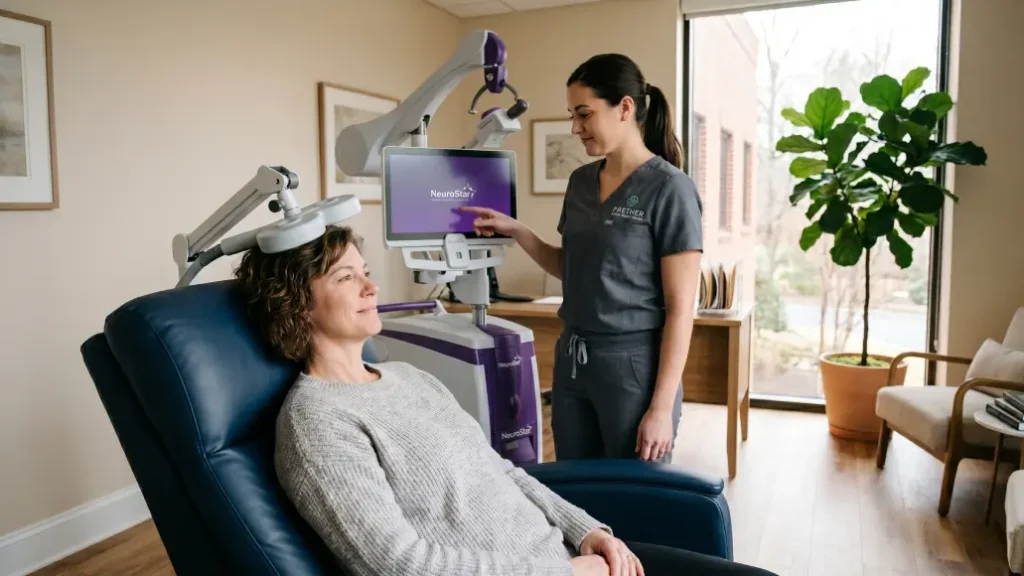

NeuroStar® Advanced Therapy uses FDA-cleared TMS to treat treatment-resistant depression. At Atlanta Spravato & TMS Center we explain how it works, who’s a candidate, and what to expect.


Table of Contents
Depression is one of the most common and disabling mental health conditions worldwide. For many people, medications and therapy help restore balance. But for others, traditional treatments don’t provide enough relief. This is where NeuroStar® Advanced Therapy, a leading form of Transcranial Magnetic Stimulation (TMS), offers hope.
At the Atlanta Spravato & TMS Center, we specialize in providing this innovative, FDA-cleared therapy for patients struggling with treatment-resistant depression. If you’ve ever wondered how NeuroStar works, whether it’s effective, and if it might be right for you, this guide offers a deep dive into everything you need to know.
What Is NeuroStar® Advanced Therapy?
NeuroStar is a non-invasive, non-drug treatment for depression. It uses magnetic pulses to stimulate underactive areas of the brain linked to mood regulation—particularly the left dorsolateral prefrontal cortex.
Unlike medications that work systemically throughout the body, NeuroStar targets brain circuits directly, making it a valuable option for patients who haven’t found success with antidepressants.
According to the NeuroStar clinical data, more than 5 million TMS treatments have been delivered in the U.S., making it the leading TMS brand nationwide.
How Does NeuroStar Work?
NeuroStar TMS uses a magnetic coil placed on the scalp. During each session:
- Magnetic pulses pass painlessly through the skull.
- These pulses stimulate neurons in the prefrontal cortex, the part of the brain underactive in depression.
- Over repeated sessions, neural pathways are strengthened, helping restore normal mood regulation.
Think of it as “physical therapy for the brain.” Over time, the stimulation helps the brain rewire itself, leading to lasting improvements in mood.
What Makes NeuroStar Different?
There are other TMS devices, but NeuroStar stands out because:
- It is FDA-cleared for treatment-resistant depression.
- Clinical studies show remission rates of up to 37% and response rates of over 60%.
- It is non-invasive—no anesthesia, no surgery, no downtime.
- It has been proven safe with minimal side effects (usually mild scalp discomfort or headache).
The Mayo Clinic supports TMS as a highly effective option when medications alone don’t work.
Who Can Benefit from NeuroStar?
NeuroStar is most often recommended for patients with major depressive disorder (MDD) who:
- Have tried at least two antidepressants without sufficient improvement.
- Experience side effects from medications that limit long-term use.
- Want a non-drug alternative for managing depression.
At the Atlanta Spravato & TMS Center, we also evaluate patients with:
- Anxiety symptoms that overlap with depression.
- Postpartum depression (in select cases, with medical approval).
- Co-occurring conditions where traditional treatments aren’t enough.
What to Expect During NeuroStar Treatment
Patients often wonder what a NeuroStar session is like. Here’s what happens at our Atlanta clinic:
- Consultation & Assessment
- A provider reviews your history, previous treatments, and current symptoms.
- A personalized treatment plan is created.
- First Session (Motor Threshold Mapping)
- The NeuroStar coil is positioned to find the right stimulation strength for your brain.
- Daily Sessions (5 days per week)
- Each session lasts about 19–37 minutes, depending on protocol.
- You sit comfortably in a chair, awake and alert.
- There’s no need for anesthesia or sedation.
- Treatment Course
- Most patients complete about 36 sessions over 6 weeks, followed by taper sessions.
- After Treatment
- You can drive yourself home immediately.
- Many patients notice improvement after 2–4 weeks.
Effectiveness of NeuroStar
The results are impressive. Clinical studies show:
- 1 in 3 patients achieve remission (complete symptom relief).
- 2 in 3 patients respond positively, with significant improvement.
- Benefits can last for months or years, especially with maintenance sessions.
A study in the Journal of Clinical Psychiatry confirmed that NeuroStar TMS offers long-term durability, with many patients maintaining remission for at least 12 months.
Side Effects and Safety
Unlike medications, which can cause weight gain, fatigue, or sexual side effects, NeuroStar has very few risks.
Common side effects:
- Scalp discomfort during treatment
- Mild headache after sessions (usually temporary)
Rare risks:
- Seizures (extremely uncommon—less than 0.1%)
Overall, NeuroStar is considered safe and well-tolerated by most patients.
The Patient Experience
Patients often describe NeuroStar treatment as life-changing:
- “It’s like the fog finally lifted.”
- “I didn’t realize how much depression controlled my life until I felt better.”
- “I wish I had tried TMS sooner.”
By combining NeuroStar with other treatments such as therapy, lifestyle changes, and in some cases Spravato (esketamine) therapy we maximize outcomes for patients in Atlanta.
How We Help at Atlanta Spravato & TMS Center
We are proud to be among the leading providers of NeuroStar TMS therapy in Atlanta, GA. Our services include:
- Expert providers specializing in treatment-resistant depression.
- Personalized care that integrates therapy, medication, and advanced treatments.
- State-of-the-art equipment with comfortable, patient-centered facilities.
- Ongoing support before, during, and after treatment.
Conclusion
NeuroStar Advanced Therapy is more than just another treatment option—it’s a proven, non-invasive solution for people who feel stuck after trying medications and therapy without success.
At Atlanta Spravato & TMS Center, we bring cutting-edge technology together with compassionate care, helping patients reclaim their lives from depression.
If you’ve been struggling with treatment-resistant depression, it may be time to ask: “Could NeuroStar be the breakthrough I need?”
References:
- NeuroStar Official Clinical Data
- Mayo Clinic – Transcranial Magnetic Stimulation
- National Institute of Mental Health – Depression
- Journal of Clinical Psychiatry – Long-Term Outcomes of TMS